
This is a Matteo fragment. Matteo is character, who is gradually coming to life through such fragments as can be written with one-dip-of-the-pen–an antique “scratch pen” given to me many years ago.
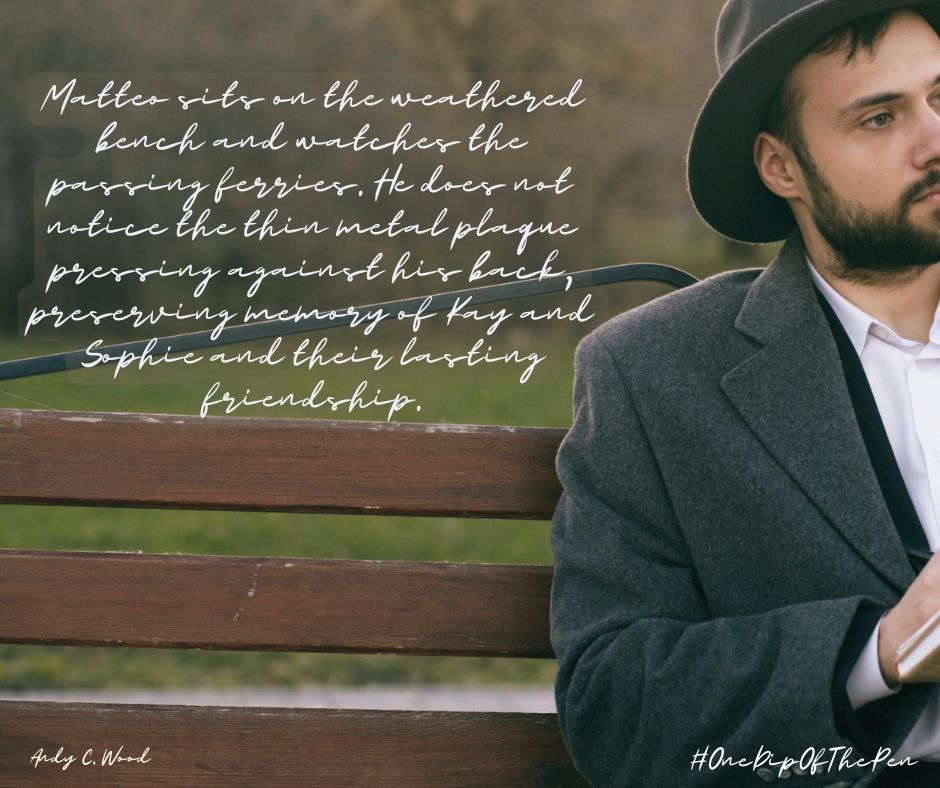
Matteo sits on the weathered bench and watches the passing ferries. He does not notice the thin metal plaque pressing against his back, preserving memory of Kay and Sophie and their lasting friendship.
Craft Notes
This fragment was inspired by just such a plaque, on just such a park bench, by just such a river. I assume that Kay and Sophie were real people. Beyond that, I do not know their story; nor do I think the fragment gives me permission to invent one.
What interests me is the boundary between what is public and what is private. The details of their friendship remain private. What becomes public is the trace it leaves behind. Friendship leaves a mark on the world. Sometimes those marks are visible and ask to be noticed.
The plaque in the fragment presses physically against Matteo’s back. In that sense, memory and friendship exert a kind of gentle pressure. They invite attention and response.
Matteo does not notice the plaque. But he may come to do so. That would then be Matteo’s story.
As a writer, I am interested in encouraging my readers to contemplate not only Kay and Sophie and their friendship, but also the possibilities facing Matteo, their own friendships, and the traces those relationships leave in the world.
How we choose to notice such traces, and how we choose to respond to them, may itself become a form of care.
The fragment is intentionally restrained. It does not attempt to explain the friendship, sentimentalise it, or transform it into a symbol larger than itself. The bench, the ferries, the river, the plaque–these remain ordinary things. But ordinary things sometimes carry evidence that human beings cared for one another.
There is perhaps also a meeting here between several strands of my writing life: the moral imagination of Sunburnt Speculations, the attentiveness to memory and place found in Heritage People, and the relational sensibility that sits beneath my post-law peacemaking work.
The fragment does not argue for any of these things directly. It simply allows them to press lightly against the scene, much like the plaque itself.
And it begins to test how we might write companionably within a shared but distant circle of memory.


Leave a comment