
The Task: “Describe three places you have been. Don’t worry about pretty words; mention the important and some unimportant details you remember.”
Novakovich, Josip. Fiction Writer’s Workshop (p. 40). Penguin Publishing Group. Kindle Edition.
“Braeside” 1965
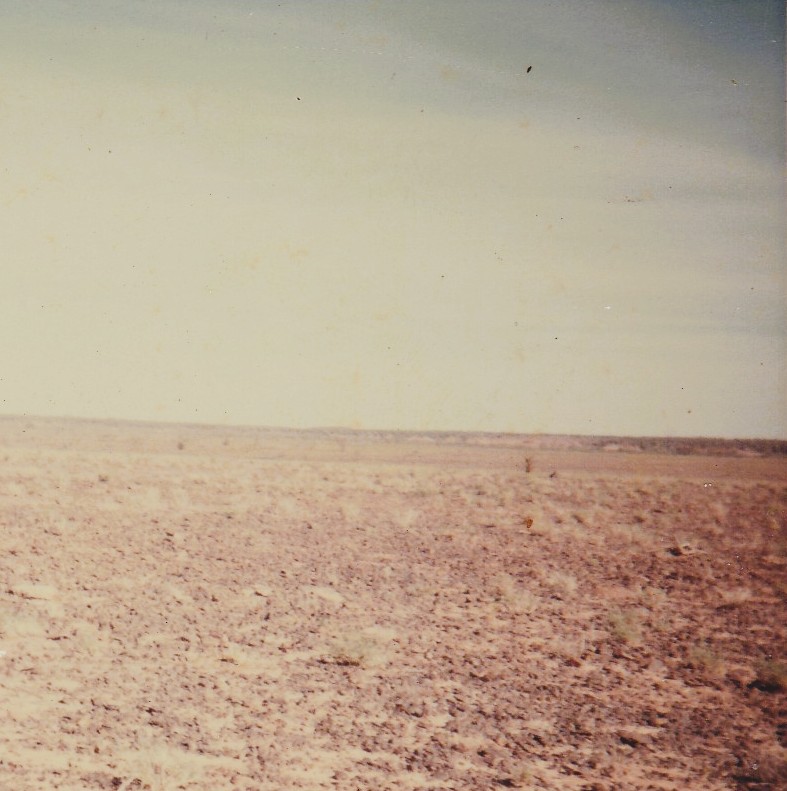
There were only two seasons in Far Western Queensland’s Channel Country when Christy and his father went on to Braeside in 1965 – dry and bloody dry. If the locals told you it was bloody dry, you knew for sure it was. And that was about as much as you’d get from them.
The country was still mostly sheep back then – marginal even in good times. In drought, you might be lucky to get saltbush. Newcomers were talking up cattle – Droughtmasters and such. But the drought had gone on too long for any to give it a serious go. Here and there a Southern Cross windmill, refusing to give up, would wearily pump water to part fill a turkey nest. But there wasn’t much point. Most stations had destocked. The sheep – too poor and costly to transport to market – were either shot or they just fell over, lacking the will to get up again.
In 1965 on Braeside, it was bloody dry. You could see it in the Black Kites, doom circling and looking for a feed. You could see it in the red dust that got into everything, and you could see it behind the locals’ bloodshot eyes as they destocked a few more wethers. You could see it, sure – but Christy learned not to look too closely.
The Homestead
The “homestead” – such a word as brings to mind pastoral scenes of homely farm life and modest prosperity – Mother cooking up something in a rustic kitchen or arms deep in suds; Father coming in from inspecting the crops ready soon for harvesting; Children playing in a fenced yard; a few plump chooks, excited dogs, a lazy cat…
The homestead on “Braeside”, when Christy and his father arrived late on a summer afternoon in 1965, was nothing like that.
Braeside was – it’s gone now, absorbed into consolidation properties – a thousand square mile sheep station in Far Western Queensland’s Channel Country, a day’s trip by Land Rover southwest of Boulia. At least, it would have been a sheep station if it had been stocked. But the stock had been moved off years earlier. Christy’s father spoke of cattle, but that wouldn’t be until it was grassed again, dams filled, and fences put in order. Father was there to see what it would take.
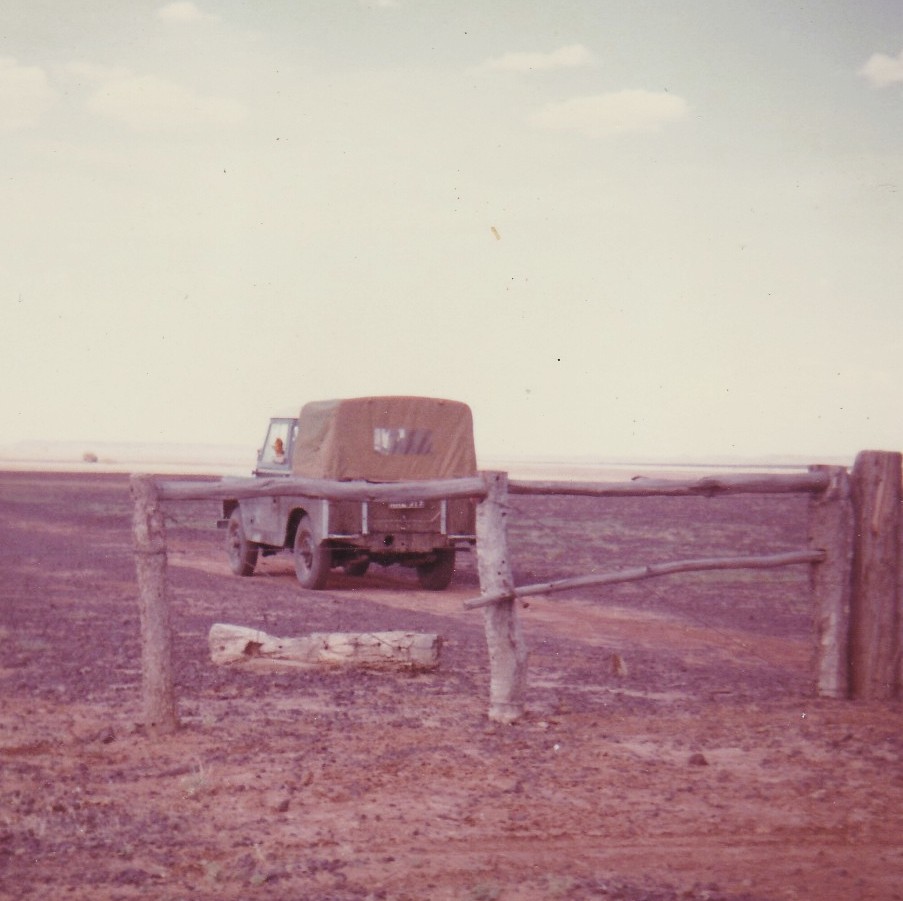
Christy jiggled the latch to open the gate. He was Father’s offsider on this trip. He closed the gate, took a Box Brownie photo and ran to catch up with the vehicle – slowly moving away as if to leave him there. It was a game they played. But it would be good to get in out of the heat.
They walked up the wooden steps together. The front door was not locked. No need for locks. No one ever came out this far. The door squeaked on its hinges, grinding over the uneven veranda planks as though complaining at the intrusion. Inside, dust had got into everything – a fine red metallic smelling powder. By the little light that came through the dirty windows they could see a couple of stained hessian camp beds side by side in the main room. And that was all … except for the spiders. A colony of red backs had created a silken palace for themselves, living like kings feasting on flies blown in through the torn screens by a hot north-westly.
Father drew some water from the homestead pump. He splashed on Christy. The water was red from rust or dust. A sort of blood baptism to signify arrival. It had been a long drive and Christy was feeling the effects of heat stroke. Father revived him with tinned rice-cream and sugar with a teaspoon of whiskey.
They spent the night there. Next day, Father seeing clouds through the binoculars, said they’d better be heading back.
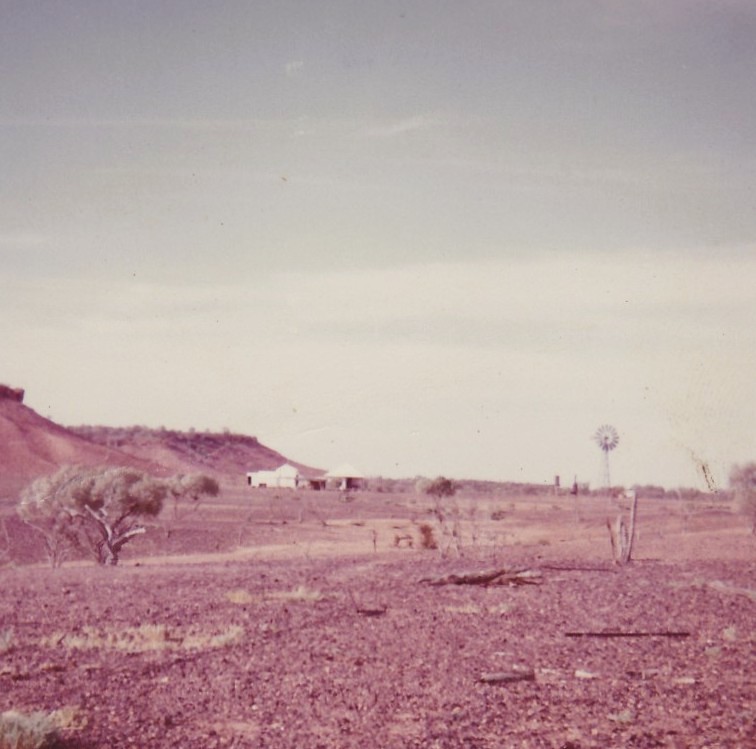
“COWLUNK” STATION SHEARERS’ QUARTERS
Christy and his father didn’t make it back before the drought broke. Father had planned the first stage of their return trip as a long haul to Winton followed a quick run into Longreach before the flood waters arrived. Longreach could flood without a drop of rain. From there, they’d have the “Midlander” as a rail option to Rockhampton then south down the Bruce.
But the channels got up not long after they’d driven through Boulia. Christy’s job as Father’s offsider, then, was to wade the channel crossings in togs with a stick to check the depth. If the water reached his chest, he’d come out again. Father would place a few rocks at the water’s edge, and they’d wait to see if the water was rising or falling. At this crossing, the flood was rising.
In 1965, station homestead hospitality still extended to stranded travellers, especially to neighbours – even if they might be from properties hundreds of miles away. And the nearest reachable homestead was Cowlunck. Father explained that “Cowlunck” was under station managers, but they were good people who knew the drill. He drove carefully up to the homestead – much bigger and better appointed than Braeside, Christy noticed. Christy was careful with the gates.
A station greeting between bush folk has its own peculiar pace. It is unhurried. Almost liturgical. There are opening words and reflective pauses whilst the participants look at the land and wordlessly acknowledge its challenges – like they are sharing something from the same bread. After a while – credentials established – Father and Christy were given the run of the shearers’ quarters for a few days whilst the roads cleared.
It had been a while since much shearing had been done on Cowlunk, and the quarters were bare. How to describe them? To Christy, they were like those flat pack cabins you could still see in holiday camp brochures – but set up for rough men, not holiday-makers. You’d go up two or three shallow steps on to a shaded veranda that had a few mis-matched cane and wood chairs strewn about. Each cabin had half a dozen rusted metal bunks with hard horsehair mattresses and a few stained pillows. No bathroom, but a cold-water basin and a few cheap glasses.
To Christy’s delight, there was a stray copy of an out-of-date Readers Digest. Lying on his stomach on his bunk he read it over and over to pass the time as they waited for the roads to clear. For Christy, it was not so very much unlike boarding school on a wet Sunday afternoon, when there’s not much to do. Christy bore the waiting with patience and resignation.
Christy and his father, didn’t see much of the station folk. There were a few glum conversations about the sheep they’d lost and fences that would need repairing. But, on their last night at Cowlunk the station folk invited Father and Christy to dinner in the big house. Christy dressed in his school uniform and blazer. Father always had him bring it in those days when graziers’ sons were still sent to the Coast to become, at least gentlemen, if not scholars.
Next day, Father and Christy drove to Longreach. Christy heard over the wireless the DJs announcing road openings and heralding the arrival of “the first verdant shoots”. Christy hadn’t seen them yet. They must have been behind him. He had done his tour as offsider, and his thoughts now turned homeward.

 Sunburnt Speculations
Leave a comment